Cycling in Galicia: Atlantic coastlines and wild mountains
-
If you click a link with an * and buy from a company’s website, I may receive a small payment. This helps fund the Outdoor Girl site and keeps it free to use with no annoying pop up adverts.
But there are a couple of crucial things you need to know about this:
It never impacts my content or recommendations – if I include something, I genuinely think will be helpful
There is no extra cost to you when buying via one of these links
For a more detailed explanation, see my policy on affiliate links, including Amazon Associate links.
For transparency, you can also find duplicate links below that don’t help fund the Outdoor Girl website.
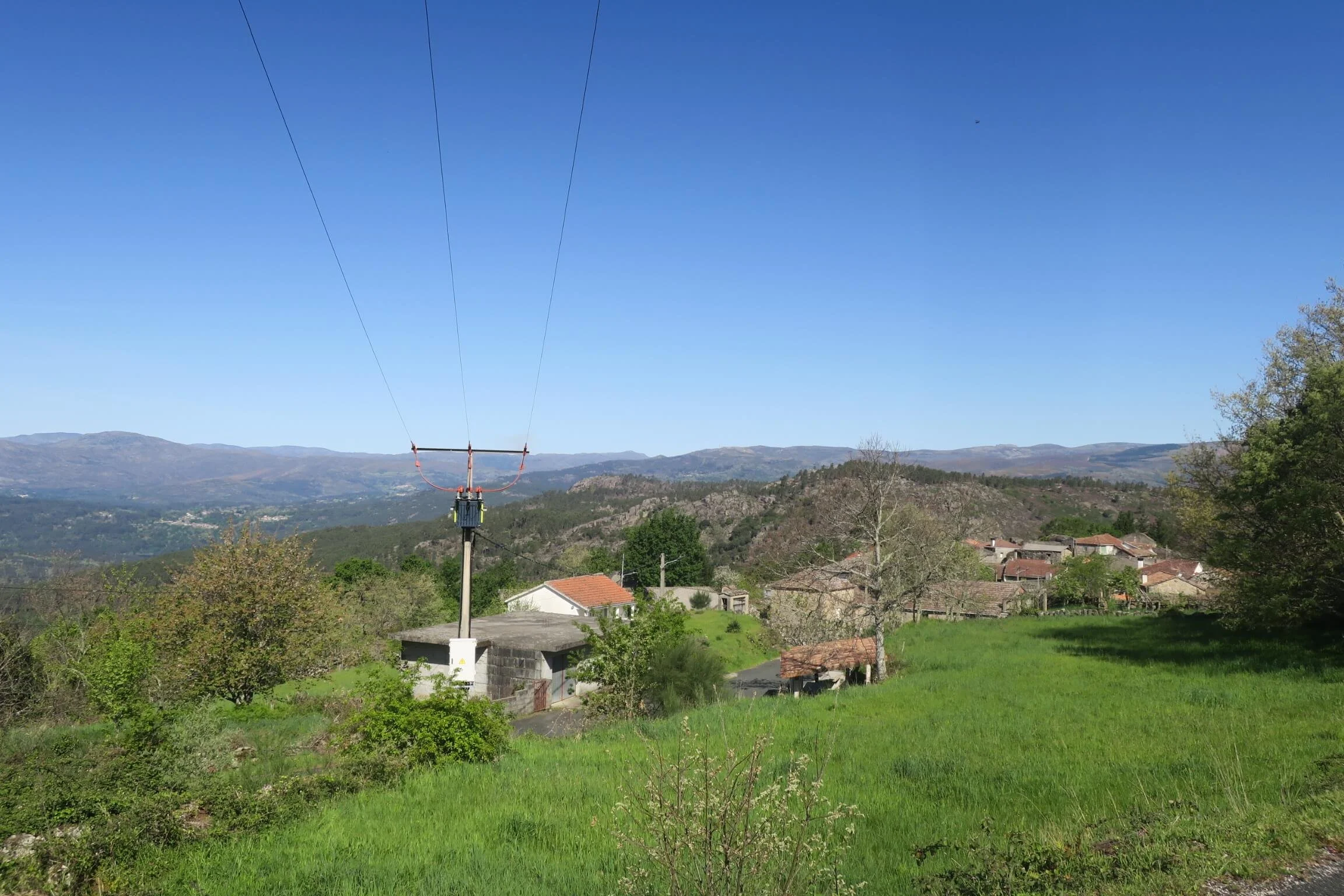
Galician village in the Xurés Natural Park
Galicia: a different side of Spain
Galicia feels very different to the rest of Spain. I’ve been on plenty of climbing trips to the inland regions around Barcelona, Valencia, Alicante, and Murcia, where the scenery is rugged, dramatic, and sun-baked. Galicia, in contrast, is greener, cooler, and influenced by the Atlantic Ocean. It’s not the Spain most people expect, but it’s one well worth visiting.
Located in the far northwest of Spain, Galicia is above Portugal (although not the same timezone). It’s a region of contrasts, with a dramatic Atlantic coastline, pristine sandy beaches, and wild, remote mountains.
We explored it by bike which for me is one of the best ways to experience it. Cycling connects you directly with the landscape and the people you meet along the way.
We rode two very different routes in southern Galicia. One was along the coast and the other through the mountains. Both began just over the border in Portugal before crossing into Galicia. While they were completely different in character, they were equally memorable.
Why Galicia is so good for cycling
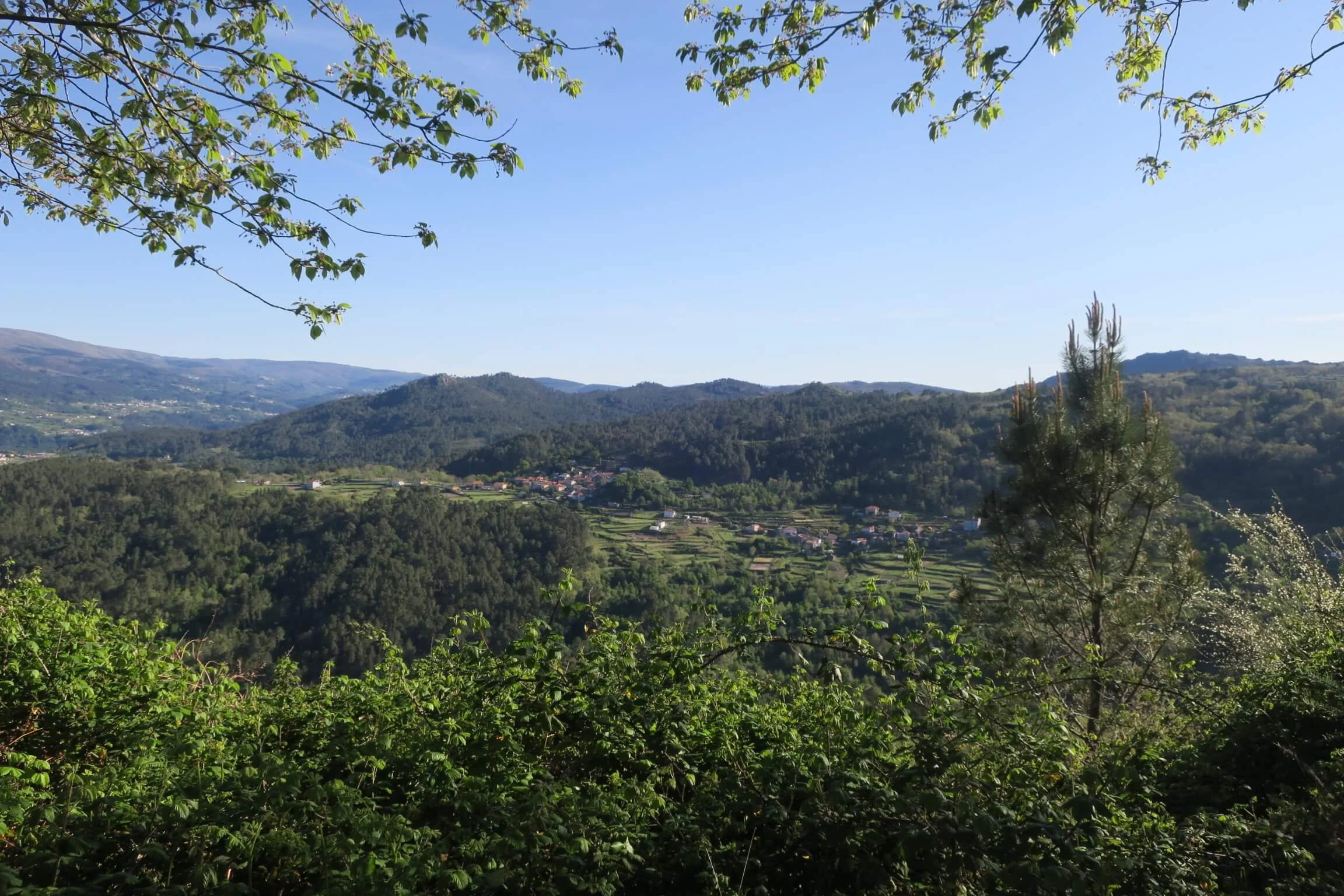
Xurés Natural Park, Galicia - Spain
Spain is a great cycling destination, with a strong cycling culture and generally respectful drivers. In Galicia, you can pair this with quiet rural roads, especially inland. It’s possible to spend hours riding through forests and mountains with hardly any vehicles.
Our routes followed a mix of smooth rural tarmac and smaller connecting roads or tracks, passing through small villages and constantly changing scenery.
We also rode sections of the EuroVelo 1 Atlantic Coast cycling route. In 2026, this was extended into Galicia, creating a fully signed route from the Portuguese border to Cape Fisterra (Finisterre).
If you’re looking for diverse cycling in a relatively quiet part of Spain, Galicia is well worth a look.
Cycling Galicia’s Atlantic coast

Rías Baixas, with Albariño vines in foreground
Galicia’s coastline is huge, spanning over 1,500 km (930 miles) along the Atlantic Ocean and Cantabrian Sea to the north. It’s full of small islands and rías (long inlets cutting into the land), with the Rías Altas in the north and the Rías Baixas in the south.
The Atlantic Coast is the most well-known side of Galicia, with a mix of fishing villages, sandy beaches, offshore islands, and sheltered inlets.
- The Rías Baixas and fishing villages
The Rías Baixas are at the heart of coastal Galicia for cycling. Here, you’ll find white sandy beaches and vineyards producing Albariño wine. We pedalled through fishing villages and small seaside towns, where life is closely tied to the sea.
Combarro was one of those a picture postcard places that really stood out. It’s a traditional village with stone granaries (hórreos) built to store crops and keep them away from rodents. Narrow cobbled streets wind between granite houses right by the water.
Sanxenxo is a livelier coastal town, with beaches, cafes, and restaurants. We cycled along the promenade, soaking up the atmosphere.
Mussel farms are everywhere along the coast, with floating platforms anchored in the rías. The Camino Portuguese coastal route also passes through this area, adding a sense of pilgrimage to the cycling experience.
- Illa de Arousa and O Grove
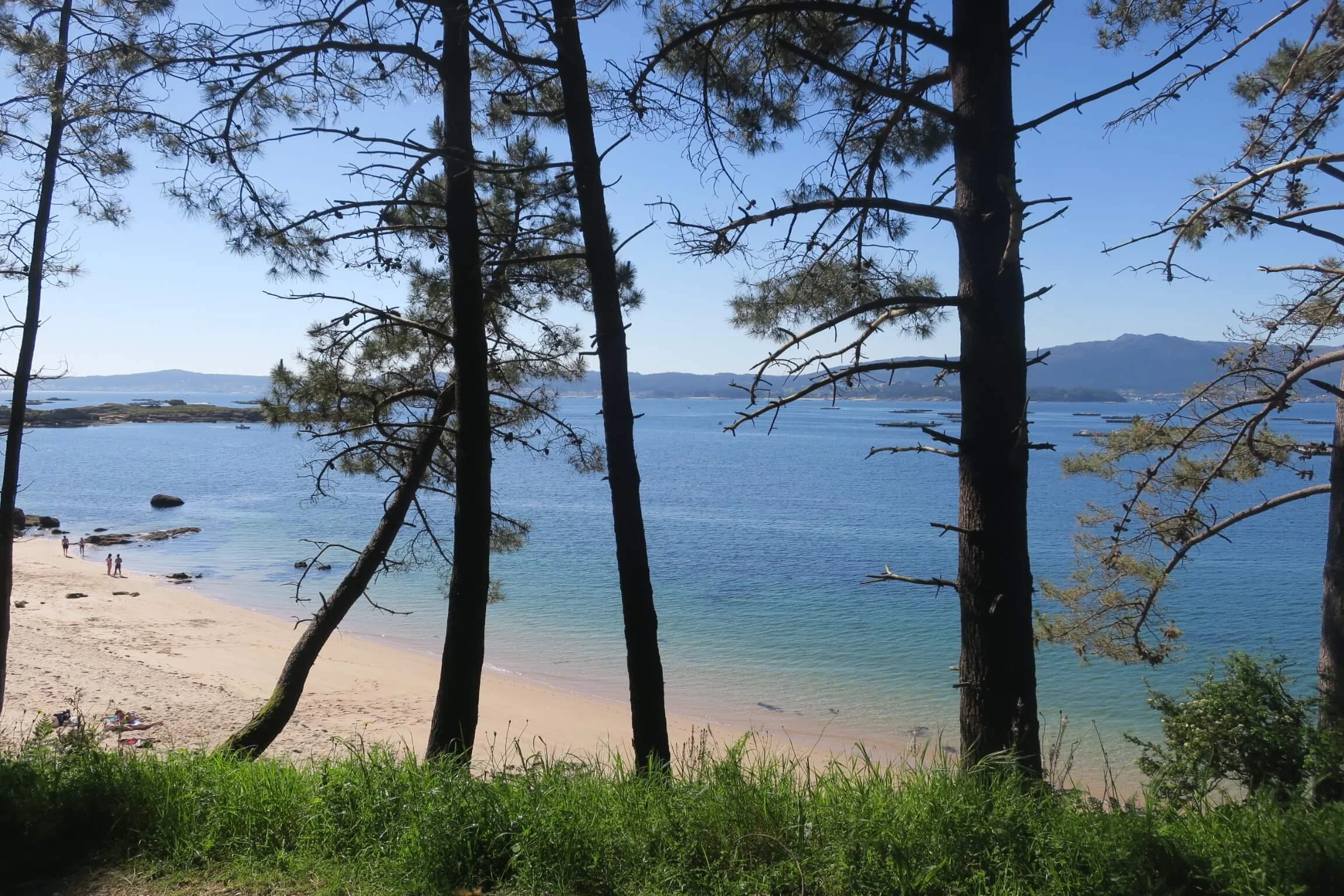
Illa de Arousa, Galicia
O Grove, a working harbour and seaside town, sits at the end of a peninsula. In summer, it becomes a popular tourist spot for Spanish and Portuguese holiday makers, but outside the peak season it has a relaxed, local feel.
We enjoyed a fantastic meal at a seafood restaurant, watching the world go by. Along the isthmus is a protected nature reserve with bird hides, making it a great place for birdwatching during the migratory seasons.
A little further north, we cycled across a 2 km bridge to Illa de Arousa. This beautiful island has sandy beaches all around, and a slower pace to life.
- Finisterre and the edge of the Atlantic
Finisterre lies in the far west of Galicia and was historically believed to be the most westerly point of mainland Spain, the symbolic “End of the World”. In reality, Cabo Touriñán, a few miles to the north, sits 124 metres further west but Finisterre still has deep cultural and emotional significance.
Many pilgrims walking the Camino de Santiago finish their journey here, at the edge of the ocean. In ancient times, this coastline was considered sacred, linked to Celtic beliefs that it was the “Altar of the Sun”, where souls departed for the afterlife.
Today, Finisterre is a small coastal town with a harbour, hotels, and seafood restaurants. It’s also possible to cycle here from Santiago de Compostela, with the journey naturally coming to an end in Finisterre.
Inland Galicia: mountains, forests, and remote valleys
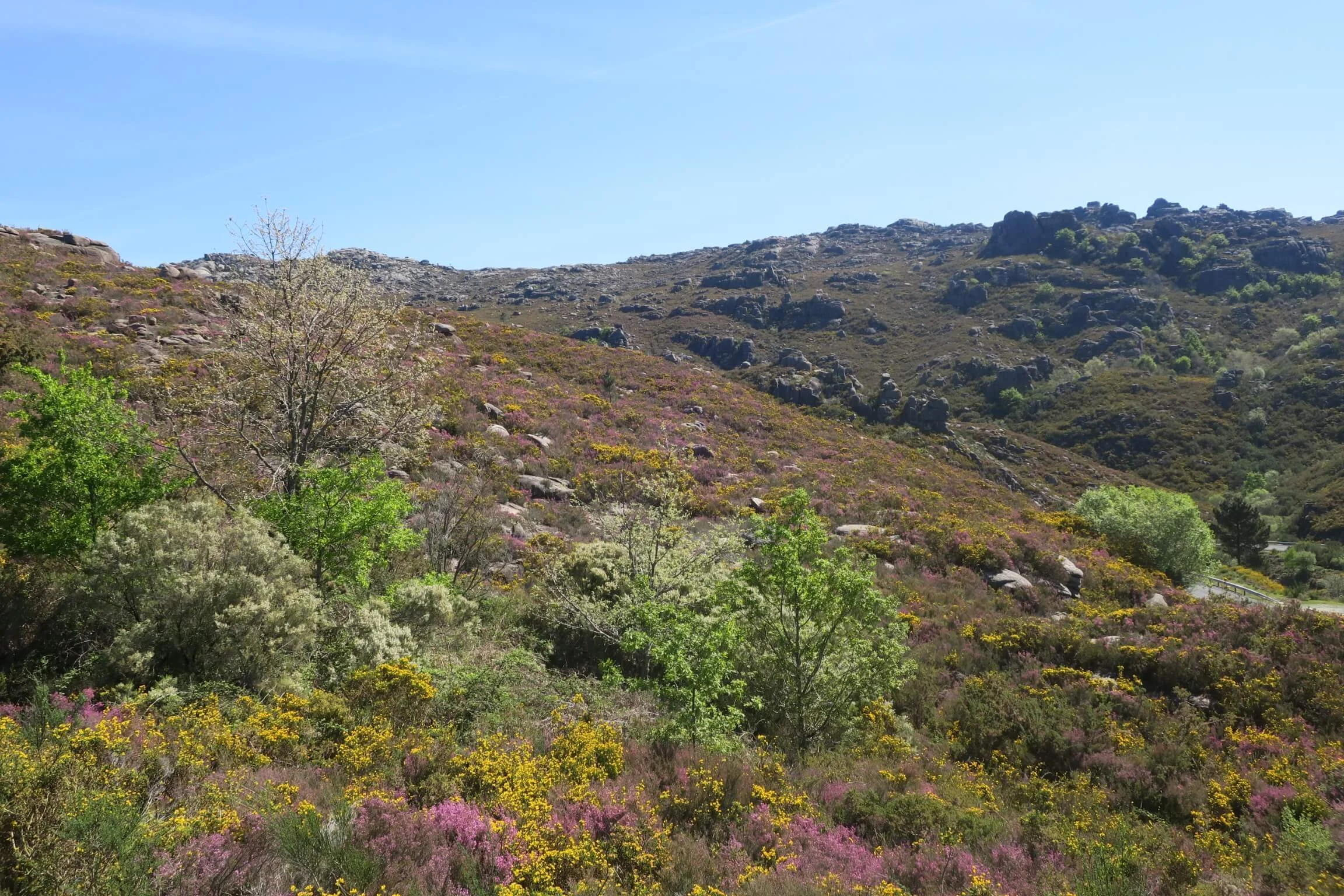
Spring colours in the Xurés Natural Park, Galicia
Away from the Atlantic coast, Galicia becomes more mountainous and is one of the most heavily forested parts of Spain. In the east are the edges of the Cantabrian mountains and, in the far south lies the Baixa Limia-Serra do Xurés Natural Park.
- Baixa Limia-Serra do Xurés Natural Park
The Baixa Limia-Serra do Xurés Natural Park is a UNESCO-protected biosphere reserve, shared with neighbouring Portugal’s Peneda-Gerês National Park.
This is a hidden gem for cyclists, with smooth tarmac roads winding through mountains, valleys, and small rural villages, often with very little traffic.
In spring, the granite mountains are covered in pink heather and yellow broom. Waterfalls flow and the valleys turn lush and green. There’s a sense of wildness here, and a real feeling of connection to the landscape.
In the small hamlet of Porqueirós, we stayed at the fabulous Casa As Fontes. It also happens to have an amazing restaurant - one of two in a village with very little else.
- Border crossings and ancient landscapes
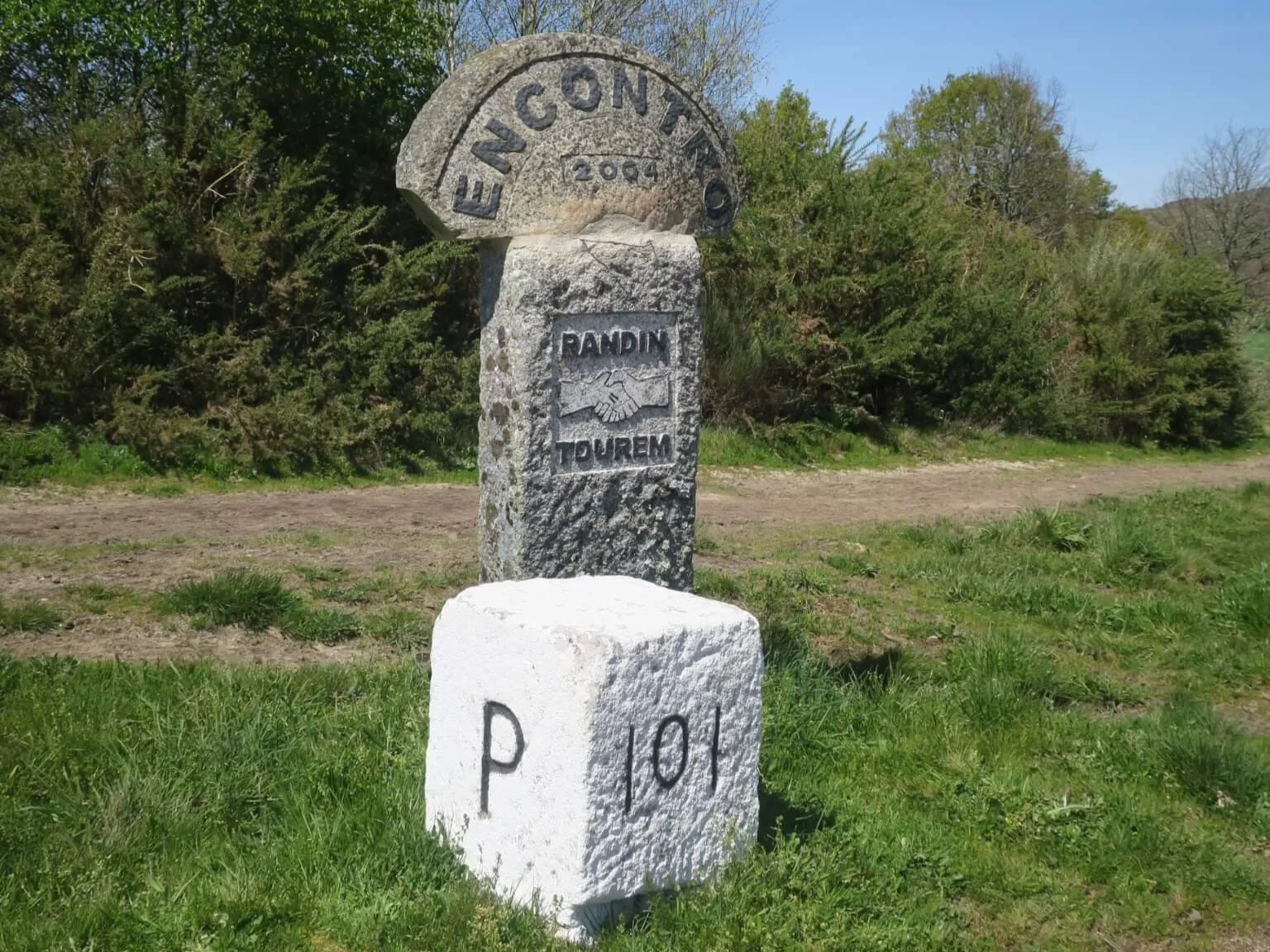
Border crossing between Portugal and Spain
From Porqueirós, we crossed the Salas Reservoir. This area is sometimes referred to as the “Valley of Death” due to the number of megalithic tombs found across the landscape.
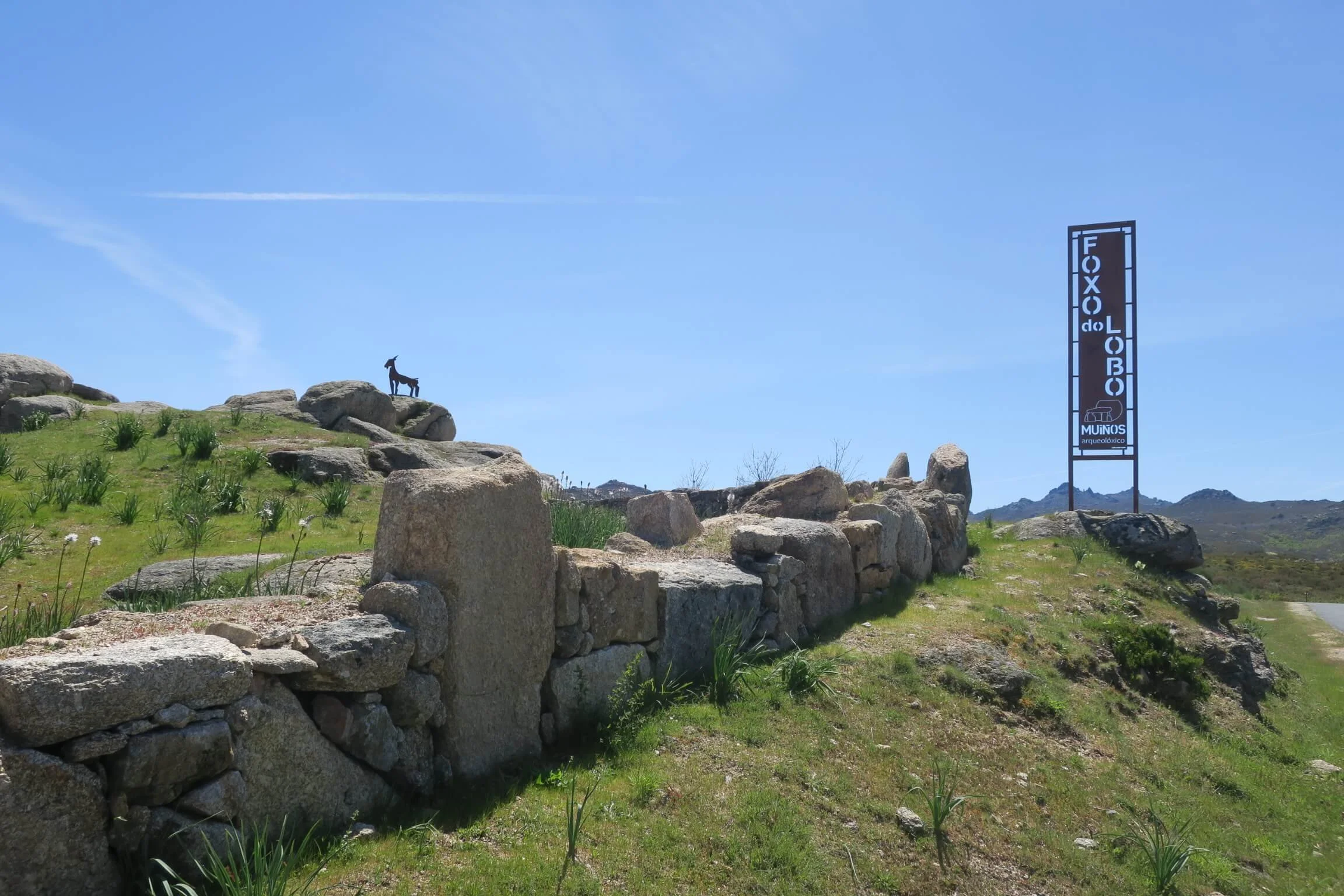
The sense of rural history is never far away here. We cycled past an ancient wolf trap, the Foxo do Lobo do Salas, built to protect livestock. Farming here traditionally relied on small terraced plots, and many villages still show traces of communal grain stores, watermills, and washing tanks. Even today, you still see people growing their own vegetables in small plots around their homes.
There’s also a quirky border crossing near the reservoir, where a Portuguese village extends into the Galician landscape. It has the added novelty of crossing timezones as you enter and leave the village.
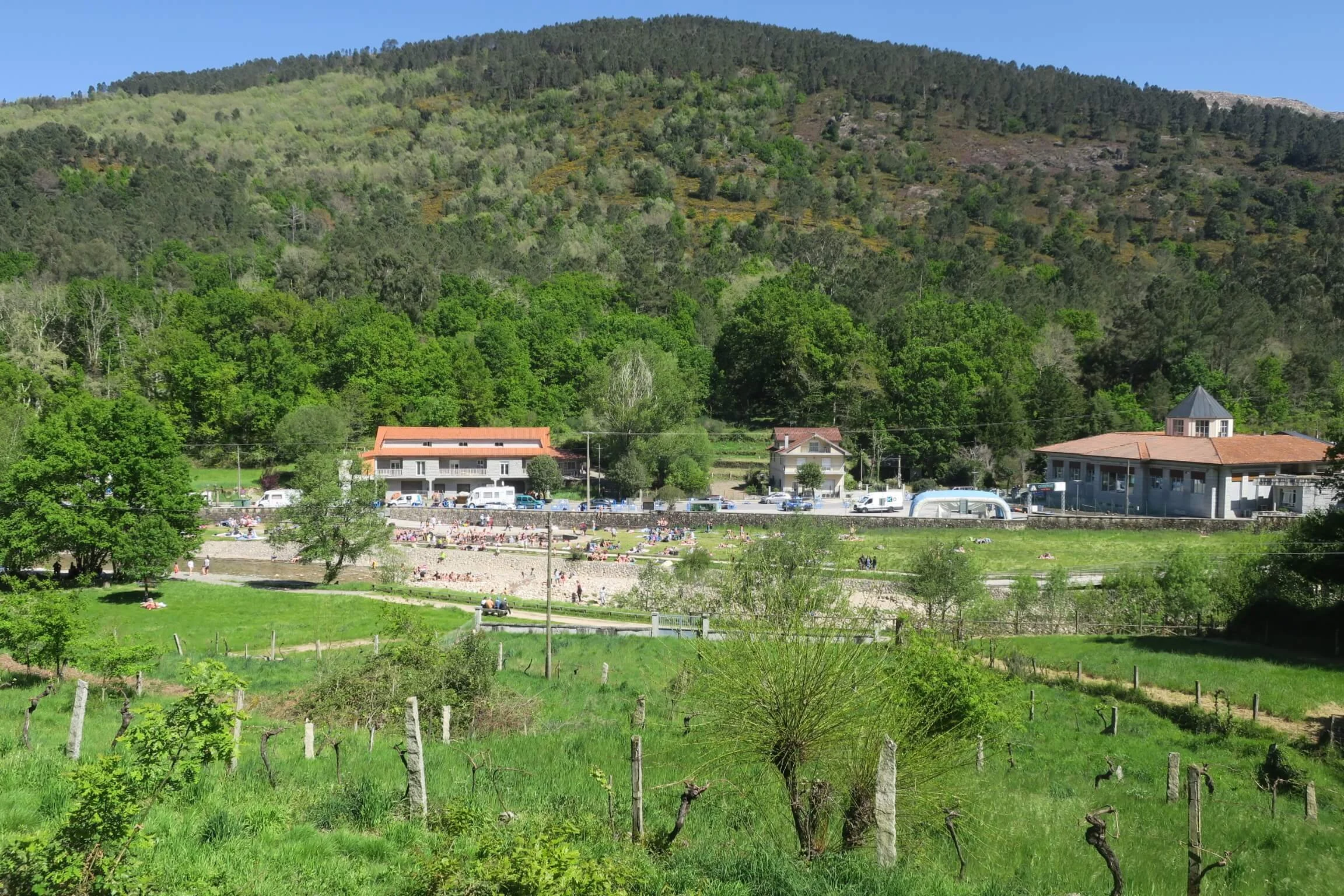
But this region isn’t only about wild mountain scenery. In Lobios, we soaked in natural hot springs that have been used since Roman times, when it was part of the Via Nova (Route XVIII) road.
The Camino and historic Atlantic coast
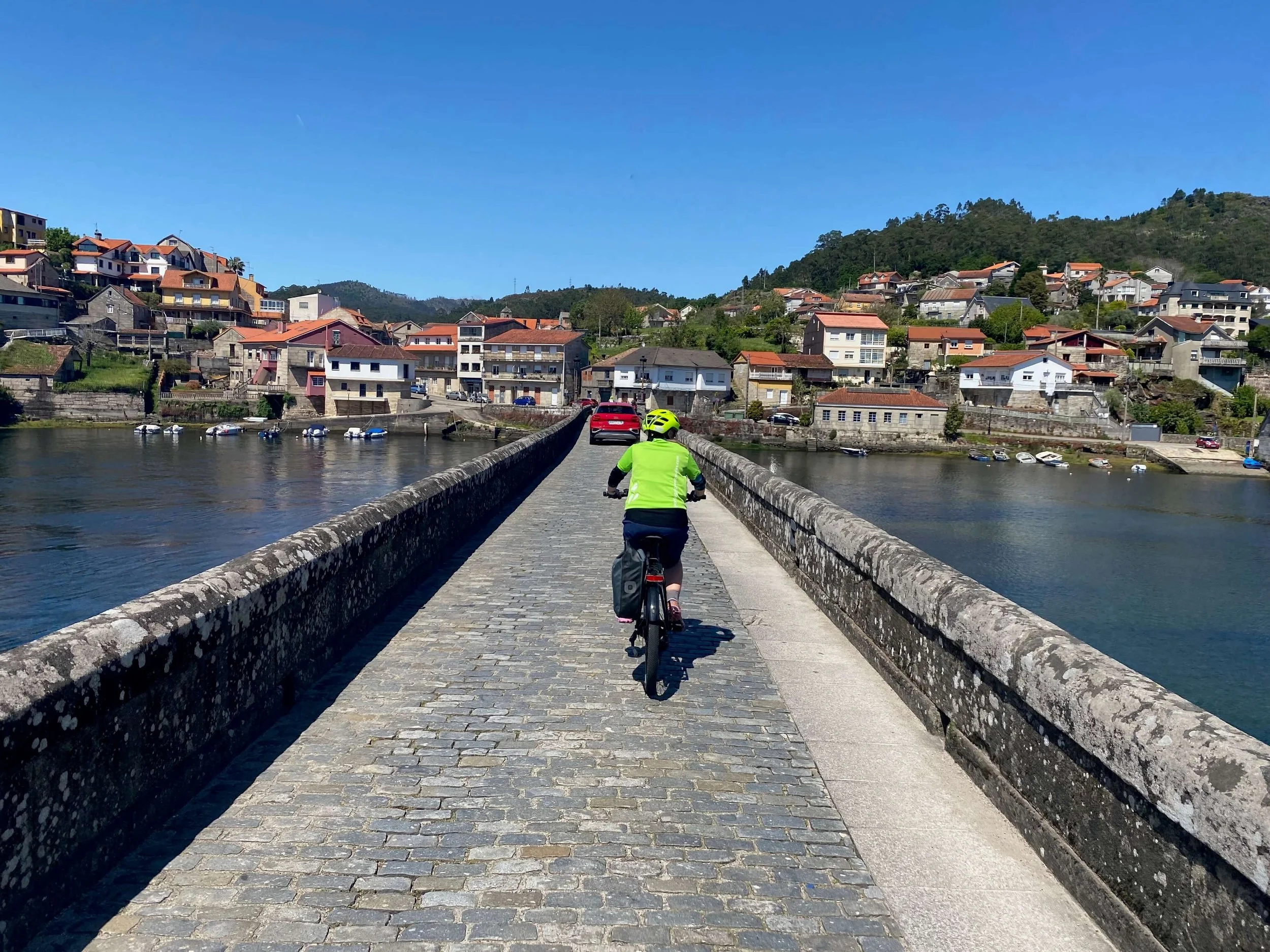
Cycling across the bridge at Pontesampaio
Galicia is jam-packed with history and cycling here gives you a real sense of the past. Santiago de Compostela, the endpoint of the Camino de Santiago, is the reputed burial place of St James (an apostle of Jesus Christ). Its old town is also a UNESCO World Heritage Site.
- Riding sections of the Camino de Santiago
The Camino de Santiago is an ancient pilgrimage route that ends in Santiago de Compostela. While many people think of it as a single route, there are actually several different Caminos. The most famous is the Camino Francés (the French Camino) but others begin further south in Spain and Portugal.
The Portuguese Coastal Route crosses the border into Galicia and follows the Atlantic northwards. There’s also a Spiritual Variant, which includes a boat journey up the Ulla River to Padrón, where it joins the traditional Camino Portuguese. We joined this section, taking our bikes on the boat.
Pilgrims walk these long distance trails, but many cycle them too. Our self-guided route along the Atlantic coast through Galicia took us on and off three different Caminos - the Camino Portuguese, the Portuguese Coastal Route, and the Spiritual Variant - before finishing at the cathedral in Santiago.
Although we weren’t following a single Camino route from start to finish, those sections still gave us a real taste of the Camino spirit. We passed pilgrims walking with staffs and scallop shells (the symbol of the Camino) hanging from their rucksacks, and were always greeted with a cheerful “Bom Caminho” (“good journey” in Portuguese). The closer we got to Santiago, the more jubilant the atmosphere became.
- Historic towns along the route
Our route passed through the border town of Tui, on the banks of the River Minho. Its imposing cathedral dominates the skyline, but the side streets are also full of small cafes and quiet corners.
Pontevedra had a lively and relaxed feel. The old town is pedestrianised and built around medieval squares, making it a great place to explore on foot. As an important Camino stopover, scallop shells and even LED lights on the ground mark the route through the town. Plus its full of tapas bars.
At Padrón, many pilgrims stop overnight before the final push to Santiago. Our boat journey on the Ulla joined the Camino Portuguese here, so we got to experience the buoyant pilgrim atmosphere both in the town and along the final kilometres into Santiago.
- Roman bridges and medieval Galicia
One thing I realised when cycling through Galicia is that history is everywhere. Roman roads, medieval bridges, and old pilgrimage routes overlap across the landscape.
In Cambados, we cycled past a restored 17th-century tidal mill. At high tide, water would enter a dam and later power the machinery as the tide retreated.
At Pontesampio, we crossed an ancient one-lane bridge. Its origins are Roman, although the current structure dates from the Middle Ages. The bridge played an important role during the Peninsula War, when the Battle of Ponte Sampaio against Napolean’s forces took place here in 1809. There’s also an ornate statue in the centre of Pontevedra commemorating the battle.
Cycling through this part of Galicia, you’re constantly passing layers of history and ancient architecture.
Galicia’s culture, language, and folklore
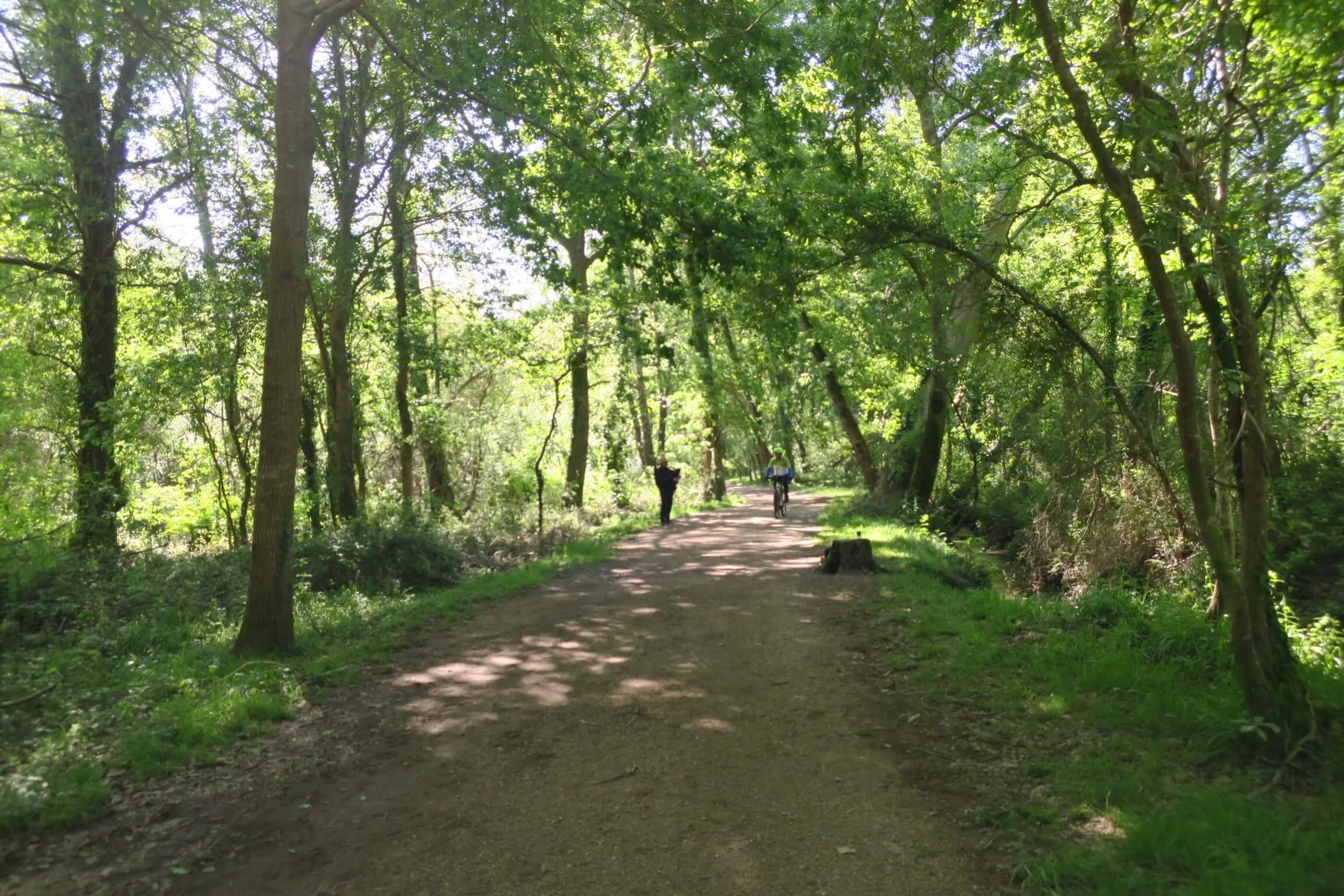
Bagpipes on the Camino Portuguese, Galicia
Galicia feels very different to the Spain most of us know. Cycling through, you quickly notice it has its own cultural identity - part Atlantic, part Celtic, part mountains. It often feels closer to Scotland or Ireland than to Barcelona and the Mediterranean coast.
- A Celtic side of Spain
The Celtic influence is strong in Galicia. It’s a pattern you see down the western edge of Europe - Scotland, Ireland, Wales, Cornwall, Brittany, and Galicia.
Soon after leaving Tui, we were cycling through woodland on the Camino Portuguese when I saw someone playing bagpipes. I was so surprised that I had to ask about their significance, and learned that bagpipes aren’t just a Scottish tradition. They’re alive and thriving in Galicia too, although called gaita here.
Folk music and dancing are also an important part of Galician culture. Honestly, parts of Galicia feel culturally closer to Scotland than to much of the Iberian Peninsula.
- The Galician language (Galego)
While Spanish is spoken across Galicia (and generally accepted as the tourist language), Galego is the traditional regional language.
“En Galicia, falamos Galego” (in Galicia, we speak Galician).
It’s still spoken every day in Galicia and is closely related to Portuguese due to their shared medieval origins. During the Middle Ages, Galicia and northern Portugal were part of the same Kingdom of Galicia, and a shared Galician-Portuguese language developed from Latin.
- Meigas, folklore, and superstition
As we pedalled northwards through Galicia, I started noticing something unusual. Witch figures appeared on the outside of many houses, and it definitely wasn’t Halloween.
I learned that Galicia is affectionately known in Spain as Terra de Meigas (the Land of the Witches). Meigas are central figures in Galician folklore and can be seen as both good and evil. They originate from Celtic and Roman beliefs, with some meigas seen as healers and wise women, using herbs and nature to help their communities, while others were associated with black magic.
The witch figures outside houses are believed to protect against evil spirits and bad luck. Rituals such as queimada, an alcoholic drink set on fire during a special ceremony, are also linked to warding off evil spirits.
A popular Galician phrase sums up the region’s relationship with folklore perfectly:
“Eu non creo nas meigas, pero habelas hailas” (I don’t believe in witches, but they exist).
Galician food and wine
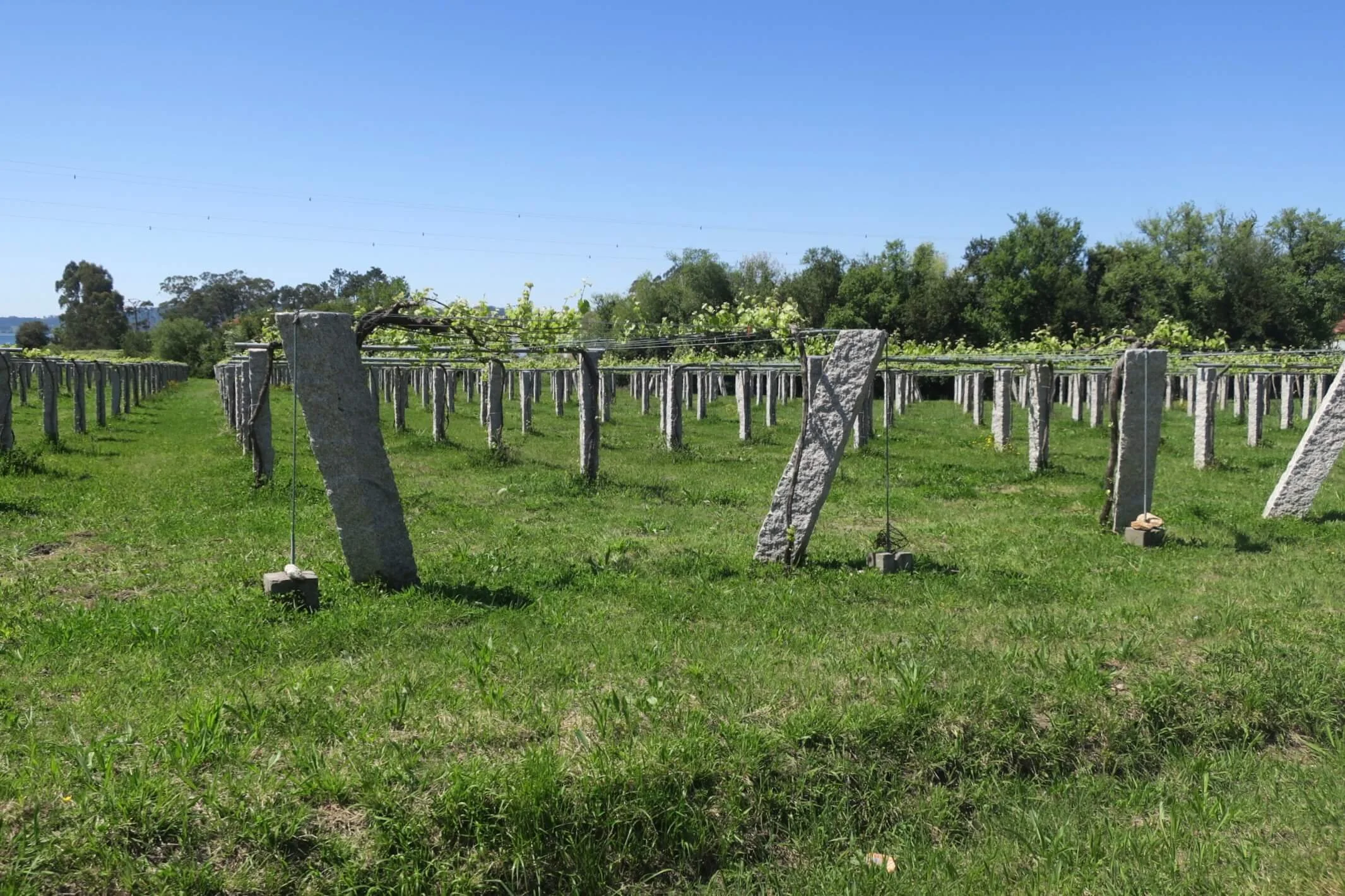
Albariño vines
The food in Galicia is simple, fresh, and delicious. Regional identities vary a little, although you’ll still find Spanish staples throughout the region. In inland areas, expect hearty stews, red meat, and dairy - often paired with red wine. On the coast, seafood dominates, alongside with the regional Albariño white wine.
- Albariño wine
Albariño is a light white wine with fresh citrus and fruit flavours. Its crispness goes well with Galician seafood and it’s a key part of the local gastronomy.
We cycled past (and through) lots of Albariño vineyards, with vines grown on high trellises. These pergola systems help with ventilation in the damp climate and historically allowed farmers to grow other crops underneath the vines.
It’s said that the monks from Cluny introduced the Albariño grape to Galicia during their travels along the Camino in the 12th century. Today, Cambados is considered the unofficial capital of Albariño wine and the centre of its production.
- Atlantic coast seafood
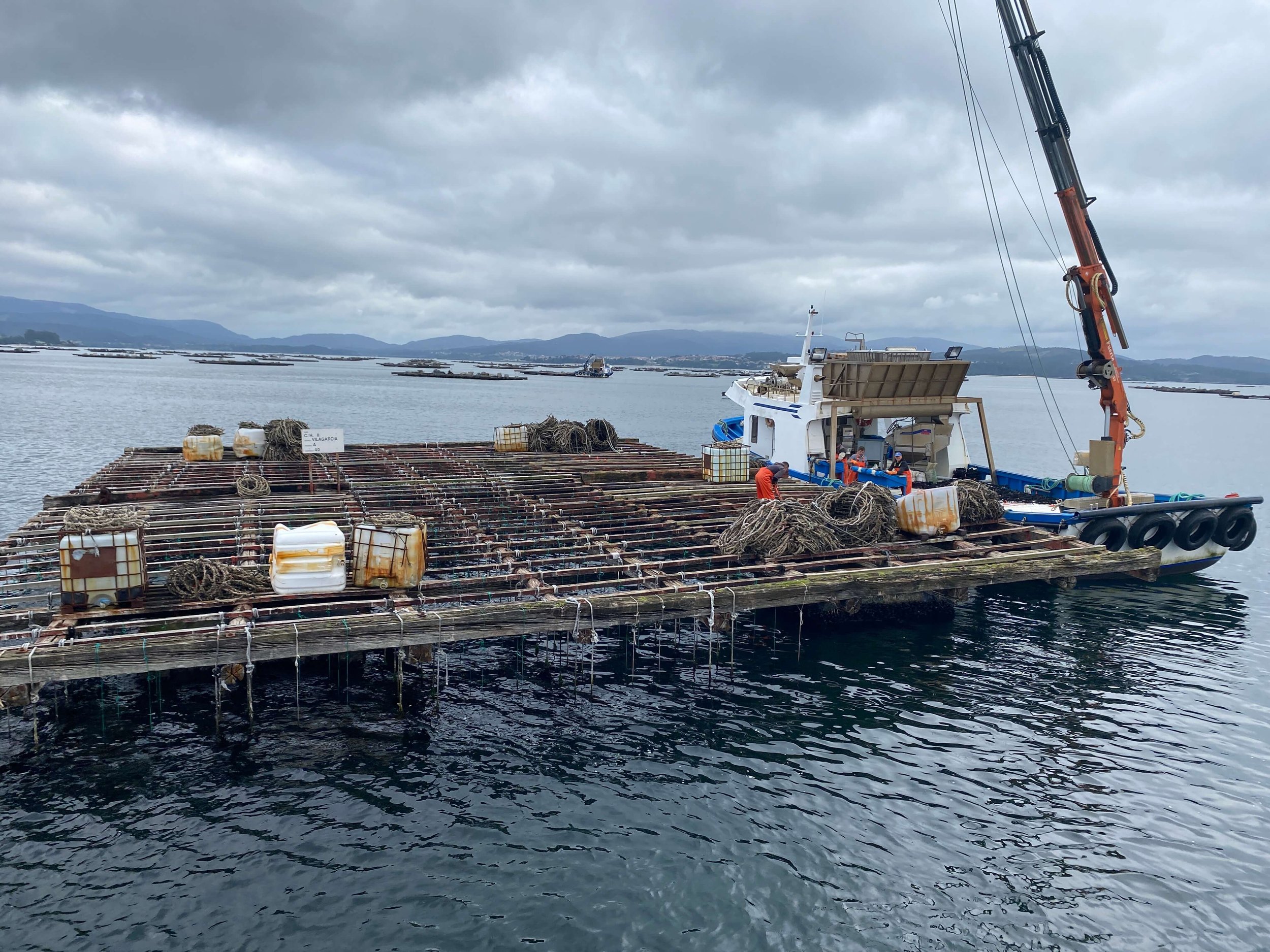
Bateas (mussel raft) in the Rías Baixas
The Rías Baixas is often described as the seafood capital of Spain. Cycling along the coast, we saw hundreds of bateas (mussel rafts) anchored in the water. But it isn’t just commercial fishing here. Early one morning in Vilanova de Arousa, we pedalled past a beach at low tide where locals were out digging for cockles and clams.
A classic regional dish is Pulpo a la Gallega (Galician style octopus). We also enjoyed a mix of seafood tapas in Padrón - although I’d recommend caution if someone offers to order you traditional pigs’ ears.
I’ll admit that I’m not a big fan of shellfish, but the fish dishes on the Atlantic coast were incredible. It was the main thing I really missed when we ventured inland to the mountains.
Practical information for cycling in Galicia
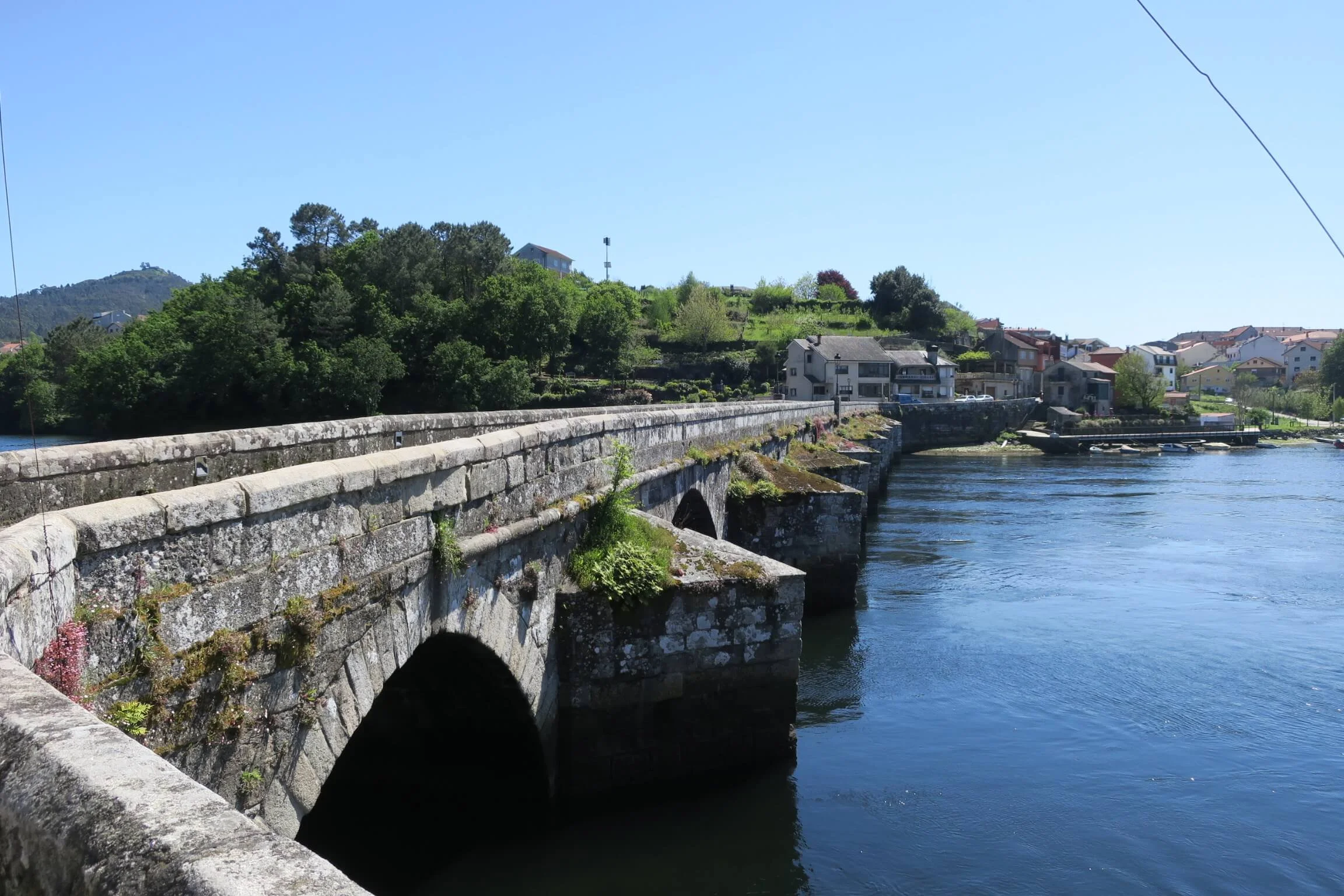
Pontesampaio, Galicia
Galicia is one of those places where cycling conditions change with the seasons. The coast can be exposed to wind, especially in winter, and rain is a regular feature of the Atlantic climate. That said, it’s also what creates the beautiful green landscape that defines the region.
- Best seasons and weather conditions
We visited in spring which was fantastic for both coast and mountains. Coastal conditions were warm but not oppressive, while the mountains were at their most vibrant, full of yellows, purples, and greens. I also loved seeing the rivers and waterfalls running high after the winter rain.
Early autumn is another good option. The weather is often stable, and the roads quieter after the summer holiday season. While Galicia is not well known among UK travellers, it’s a popular destination for Spanish and Portuguese visitors.
Winter tends to be wetter and more unpredictable, but the region can still be rideable year-round if you’re prepared for changing conditions. That said, in the Xurés mountains, higher elevations can see snow in winter.
- Roads, terrain, and riding style
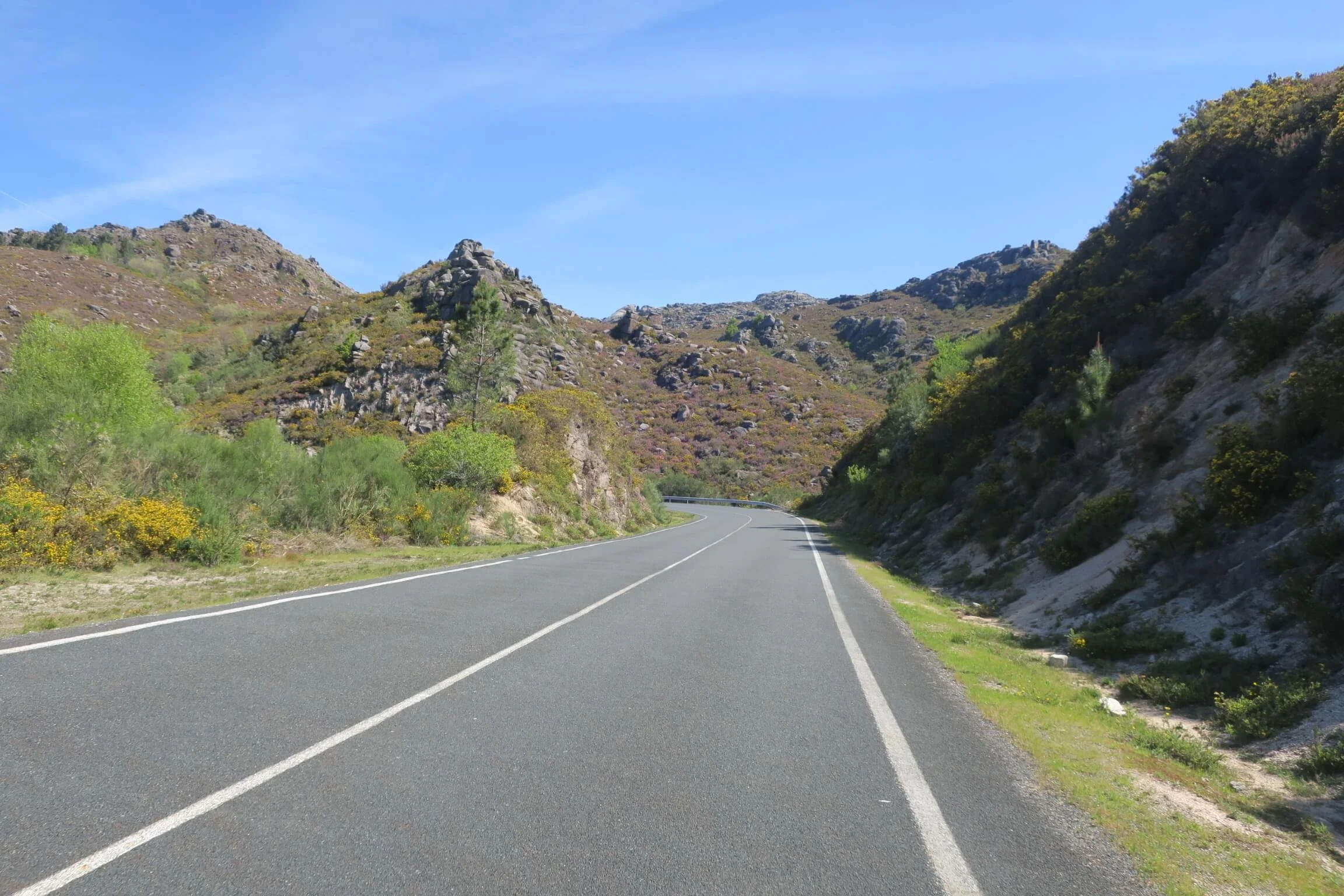
Empty roads in the Xurés Natural Park, Galicia
Road quality in Galicia is generally very good. We avoided main roads where possible and found drivers in towns and cities to be courteous and patient around cyclists.
Inland, we often followed quiet rural roads with very little traffic, especially in the mountainous areas. These were usually smooth tarmac linking small villages.
Occasionally, we cycled short sections of forest tracks or unpaved trails during our two week trip. These were always well maintained and enjoyable to ride.
Along the coast, the terrain is gently undulating, although our route began in Portugal where there were a couple of longer, steeper climbs. In the Xurés mountains, the climbs were often steeper and more sustained. We were riding e-bikes though, which made the trip feel more like exploration than performance cycling.
- Why Galicia suits multi-day cycling
Distances between towns are generally manageable and accommodation is widely available along the Atlantic coast. The Xurés region is more remote with less accommodation options, so it’s worth planning stopovers more carefully.
Above all, the landscape naturally encourages slower travel. Cycling through traditional villages and small communities gives you a closer connection to the region - something that’s easy to miss when whizzing past in a vehicle.
Why Galicia stays in my heart
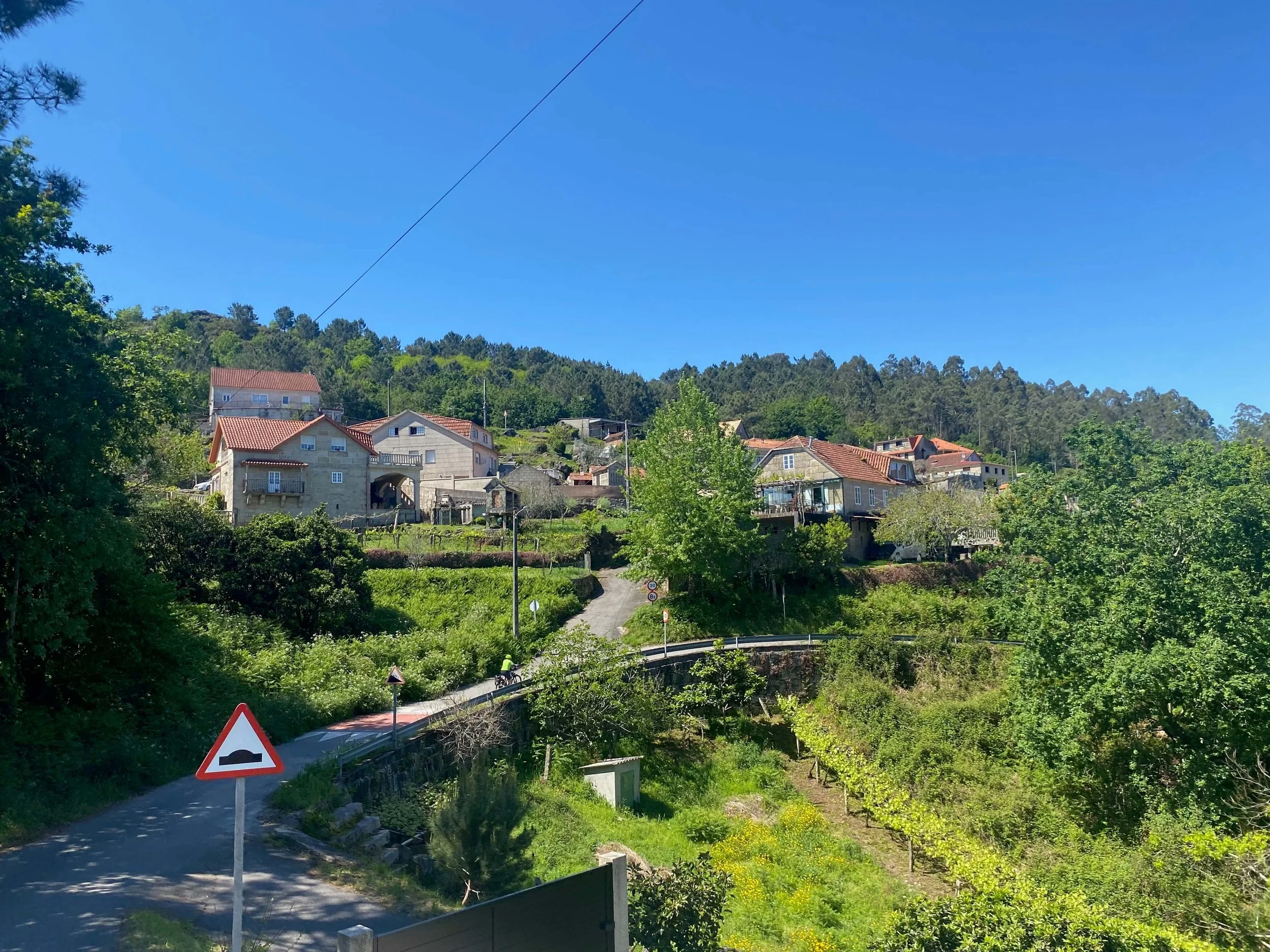
Cycling in Galicia
Cycling through Galicia stays with you.
It’s a place of contrasts - quiet roads, Atlantic scenery, mountain culture, and a surprising sense of variety packed into a relatively small area. Even after two very different trips, it still feels like we’ve only scratched the surface.
In the UK, I rarely cycle on roads, so I didn’t expect to enjoy long stretches of smooth tarmac. But in Galicia it never felt like a compromise. I never felt like I was trading my love of adventure for tarmac - more like the roads were uncovering the wildness for me.
I loved the variety and sense of space here. The coast and mountains feel like two completely different worlds, each a trip in its own right. Some cyclists will be drawn to the Atlantic coastline, with its fishing villages, islands, and seafood. Others will prefer the inland mountains, forests, and wildlife of places like the Xurés.
I’ve been lucky enough to experience both. And, while we focused on the southern part of the region, they only hint at what Galicia has to offer further north.
- If you’d like to cycle in Galicia
Both of our trips started just over the border in Portugal, and explored contrasting sides of southern Galicia.
One followed the Atlantic coastline, linking fishing villages, islands, and the Rías Baixas before continuing north towards Santiago de Compostela.
The other headed inland to the mountains of the Peneda-Gerês / Xurés region, where quiet roads, dramatic scenery, and remote villages create a very different cycling experience.
If you’re interested in walking or cycling trips in northern Portugal and Galicia, I’ve worked with a local company* that organises self-guided cycling and walking trips in the region and know the team well, so can put you in touch if helpful.
- To find out more about each route, you might enjoy:
Cycling from Braga in Portugal to Santiago de Compostela in Spain
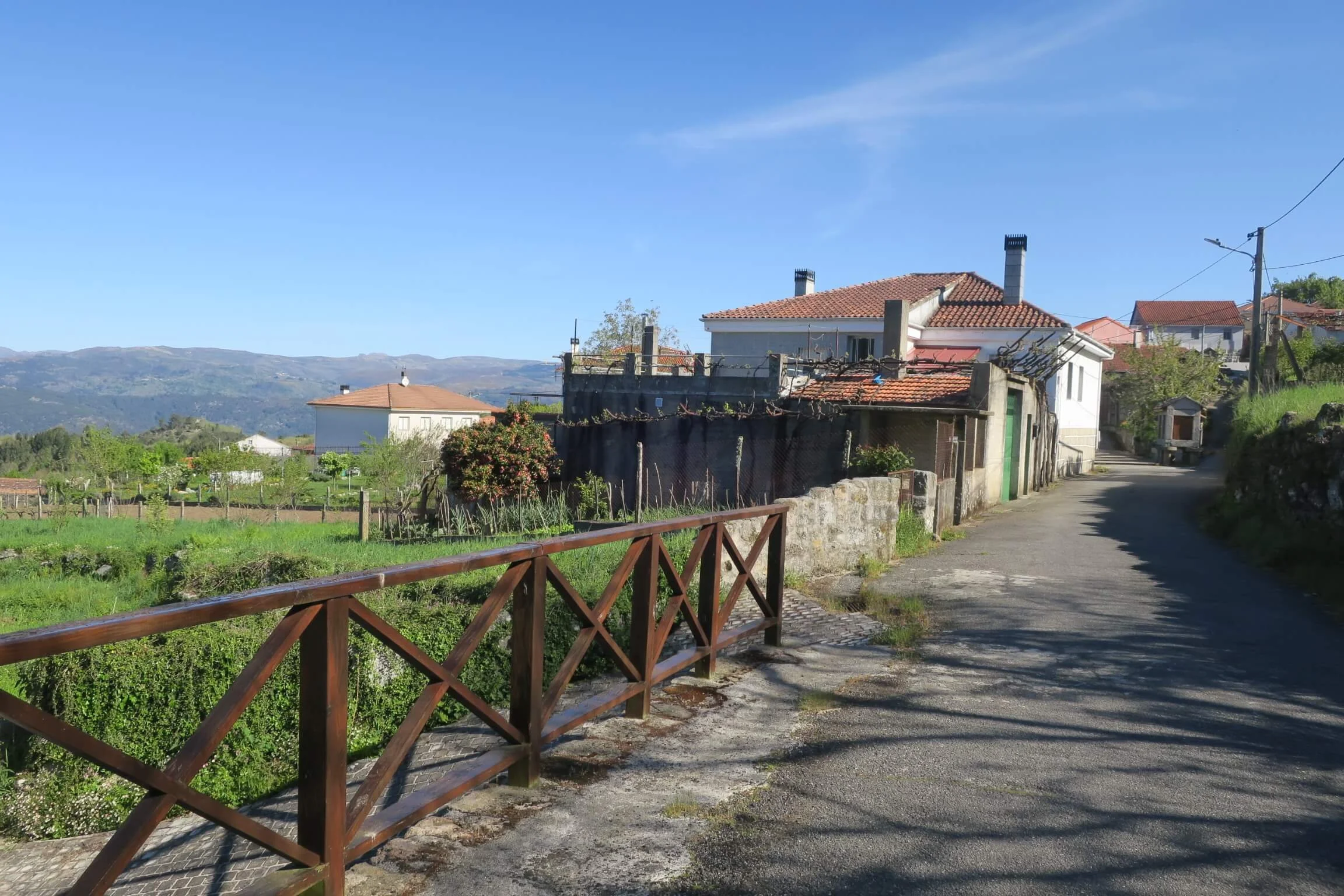
Cycling in the Peneda-Gerês and Xurês mountains
Why Northern Portugal is Europe’s hidden gem for outdoor adventure
- Stay connected
If you’d like more ideas for big trips and small adventures, you can join my newsletter below.
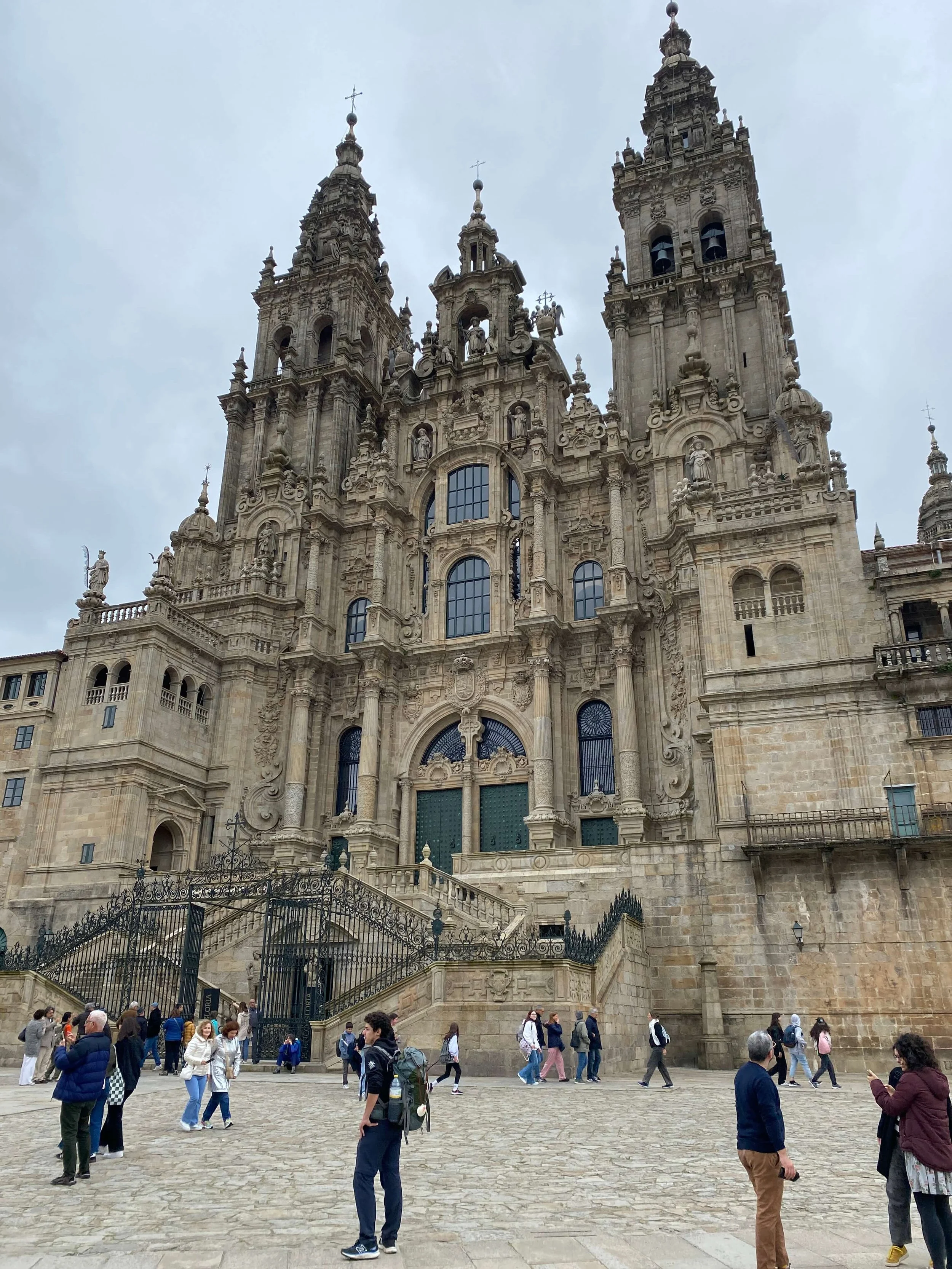
Santiago de Compostela
Outdoor Girl is run by Jacquie Budd, a UK-based outdoor writer and member of the Outdoor Writers and Photographers Guild. Alongside Outdoor Girl, she works with small businesses on websites, content, and search.
What do the links with an * mean?
Links with an * by them are affiliated which means if you get a product via this link, a contribution may be made to the Outdoor Girl website, helping it stay free to use.
You shouldn’t notice any difference in the product or cost. Importantly, the content I write is NEVER impacted by these links. For more details, please read my policy on affiliate links, including Amazon Affiliate links.
As I believe transparency is important, I’m sharing the un-affiliated links too, but note this version does not help the Outdoor Girl website.
Unaffiliated web addresses for the * links in this blog post: